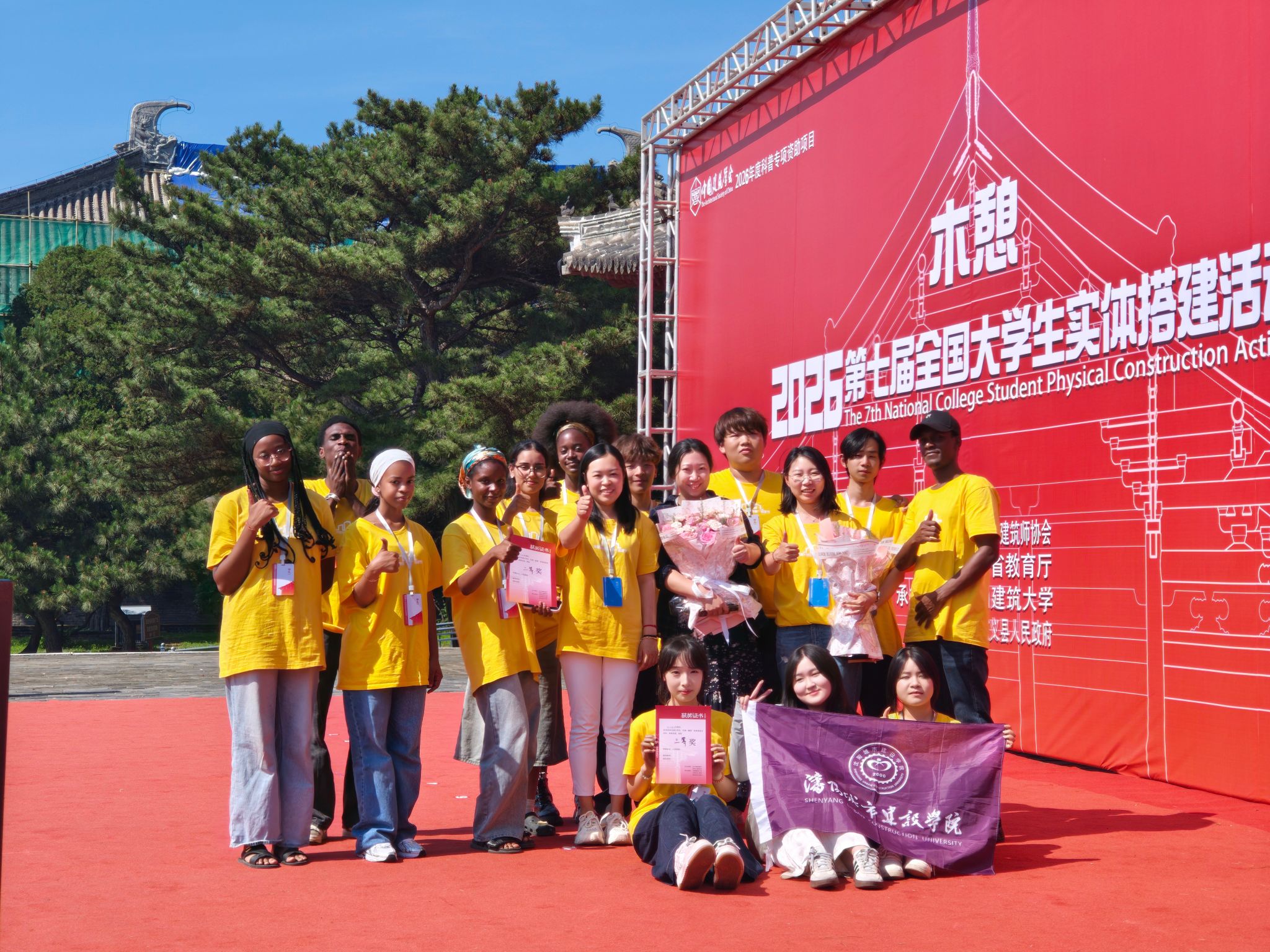
Recently, the 7th National University "Muqi" Timber Recreation & Design Competition — also known as the Liaoning Provincial University Architectural Innovation Design Competition and the Three Northeastern Provinces Age-Friendly Architectural Design Competition — came to a successful conclusion at the South Square of Fengguo Temple in Yixian County, Jinzhou City.
In this competition, an international student team of the 2024 grade from five African countries including Nigeria, Tanzania and Mali, guided by faculty members Chen Yao and Li Dan from the department of Architecture and Urban Planning, won the National Second Prize with their entry Twilight of Glory. Another team of Chinese architecture majors, supervised by Hao Miaoqi and Wang Qianci of the same department, claimed the National Third Prize for their work Linear Soliloquy.
Centered on the five-pointed star of the Chinese national flag, the international team’s Twilight of Glory symbolizes the unity and integration of overseas students who come to China for education from all corners of the globe. The design organically integrates hand-woven wooden slices and linen textures featuring traditional African craftsmanship with modern spiral stained glass light and shadow art. Through layered and progressive timber structural spaces, the work balances practical functions for the elderly to rest and reflect, as well as the spiritual pursuit of young people striving for progress.
Focusing on the core demands of age-friendly design, the award-winning Chinese student work Linear Soliloquy adopts orthogonal linear timber frames as its main structural skeleton. Horizontal components stretch out to form rest areas and sun-shading surfaces, while vertical poles create a stable yet lightweight load-bearing system. Interlaced hollowed textures allow natural light to filter through, generating orderly dynamic light and shadow effects.
Throughout the full month of competition preparation, supervising teachers provided full-cycle guidance and targeted advice. The international student team maintained close collaboration with instructors to tackle challenges as one. Confronted with dual obstacles: language barriers and the complex principles of Chinese traditional timber construction, teachers and students brainstormed solutions side by side. All supervisors elaborated on mortise-and-tenon joints, explained ancient Chinese construction techniques, and patiently corrected errors in component fabrication. Students delved deep into design drawings, refined mortise-and-tenon joints repeatedly, precisely calibrated component dimensions, and rigorously calculated structural loads. With seamless coordination between faculty and students, the teams overcame technical hurdles one after another and independently completed all procedures from conceptual design to on-site physical construction.
The two prizes claimed at the competition stand as a vivid testament to the achievements of Architecture major’s practice-oriented talent cultivation at our university. Building on the achievements of this competition, the university will optimize its teaching model tailored to the learning characteristics of both Chinese and international students, expand immersive practical courses and competition platforms, empower student development through hands-on practice, and fuel motivation via competition awards, so as to continuously improve the training quality of domestic and overseas students. Meanwhile, the university will further refine its integrated yet differentiated training system for Chinese and international students to achieve mutual advancement and higher education efficiency, cultivating more high-caliber interdisciplinary architectural professionals.
The event was co-sponsored by the Education Department of Liaoning Province and the World Chinese Architects Association, and hosted by Shenyang Jianzhu University and the People’s Government of Yixian County, Jinzhou City. After rigorous national preliminary evaluations, only 35 outstanding teams qualified for the national finals, bringing together nearly 300 teachers and students from 13 universities nationwide to compete through on-site physical construction.